
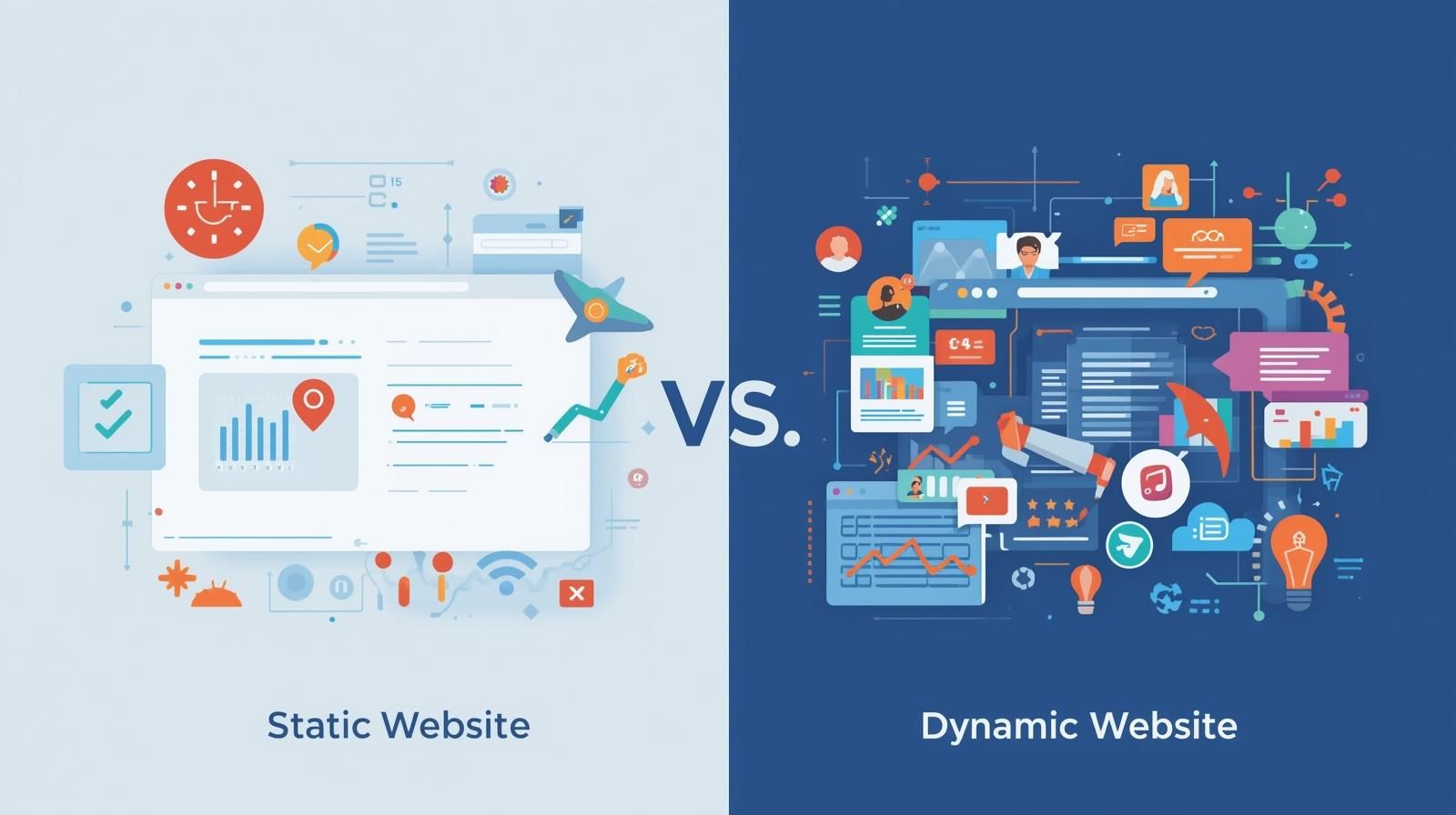
India is undergoing rapid digital growth; here an online presence is now essential, not optional. Web developers, startup founders, bloggers, small business owners, and aspiring IT professionals frequently seek clarity on the static websites and dynamic websites difference and which solution fits their requirements best.
Understanding the static website vs dynamic website difference is crucial for anyone building a website in today’s competitive digital landscape. This article explains the core characteristics of static and dynamic websites in easy-to-understand terms, using practical examples relevant to Indian users.
After reading this article, you will clearly understand the differences between static websites and dynamic websites, along with their benefits, limitations, and practical use cases, making it easier to choose the right website type for your future goals.
What Is a Static Website?
A static website is the most basic type of website. A static website consists of static web pages created using the web design coding languages of HTML, CSS, and, sometimes, JavaScript. Each page is saved as a separate file on the web server, and the page does not change, no matter how many times a single visitor refreshes the page.
When comparing static websites and dynamic websites, static websites are usually the first websites that beginner web developers create.
Features of Static Websites
-
Fixed Content
The content is the same no matter when the website is visited. Only when the developer makes changes to the code is the website able to be altered. For instance, a basic portfolio website for a freelancer in India lists their skills and contact information.
-
Basic Technology Stack
Static websites are built with only HTML, CSS, and some JavaScript. There is no storage system needed.
-
Fast Loading Speed
Static websites have no back-end processing, therefore loading is at an optimal level. This is even true for websites with back-end processing when using slower data connections in places such as India.
-
Low Hosting Costs
Static websites are cheaper to host, thus are ideal for sites that are hosted on free or shared hosting sites.
-
High Security
With fewer elements, there are fewer points of weakness. This is especially true when considering the differences between a static website and a dynamic website.
What Is a Dynamic Website?
Websites that are more advanced in comparison to static websites are the ones able to alter and adjust content based on time, location, user interactions, or data recorded within databases. Websites that are known to be in this category are news sites, social media sites, and e-commerce sites.
Key Traits of Dynamic Websites
-
Database-Driven Content
Database systems such as MySQL or MongoDB are used to hold content that is then pulled in a dynamic way.
-
Server-Side Programming
Languages such as PHP, Python, Node.js, or ASP.NET are the preferred choices for content generation.
-
User Engagement
User engagement features such as log-in systems, comments, dashboards, and real-time updates.
-
Customized Engagement
Users can have customized viewing preferences, as is the case with online learning platforms, which are widely adopted in India.
-
Scalability
Dynamic websites are flexible and can easily expand by adding more pages and features rather than by rewriting the code.
Key Differences Between Static and Dynamic Websites
The differences between static websites and dynamic websites become clear when we look at them side by side.
1. Content Management
-
Static Website
Manual intervention in the code determines when the content is changed.
-
Dynamic Website
Admin panels or Content Management Systems (CMS) enable content updates.
This is often a key factor in the static website vs dynamic website conversation.
2. Development Difficulty
-
Static Website
Simple to build and best suited for beginners, such as students in India, who are starting to learn web development.
-
Dynamic Website
Backend knowledge and the understanding of databases and server-side logic are required.
3. Speed
-
Static Website
Quicker loading speeds.
-
Dynamic Website
There are slight delays because of server-side processing, although current improvements are beneficial.
In the static website vs dynamic website conversation, speed is usually in favor of static websites.
4. Financial Considerations
-
Static Website
Development and maintenance costs are low.
-
Dynamic Website
Development time, hosting, and maintenance costs are high.
This difference in cost is significant for small businesses in India.
5. SEO Capabilities
-
Static Website:
Good SEO performance is provided if the content is optimized.
-
Dynamic Website:
Strong SEO potential with the use of automation and content scaling.
For SEO, the performance of static website vs dynamic website is a differentiating factor.
Use Cases in the Indian Context
To summarize the information on static website vs dynamic website, let us analyze a few practical use cases.
When A Static Website Is Ideal
- Personal portfolio for freshers
- Small business landing pages
- Local service providers (electricians/tutors/consultants)
- Event promotion pages
To save money, many of India’s new startups use static websites, thereby making static websites and dynamic websites the more practical choice.
When A Dynamic Website Is Ideal
- E-commerce
- Job portals
- Online education
- News and blogging
Large dynamic websites serve the Indian market due to the versatility they offer.
Advantages of Static Websites
When comparing static websites and dynamic websites, the advantages of static websites include:
- Reduced development costs
- Increased security
- Reduced costs
- Faster performance
- Simpler development
- Simplified deployment
For beginners and small businesses in India, these advantages make static websites a good choice.
Static Websites Limitations
- No real-time updates
- Manual content changes are needed to update the website
- Limited interactivity on the website
Because of the long list of disadvantages with static websites, most developers turn towards dynamic build solutions.
Dynamic websites Limitations
- More expensive to develop
- Needs regular updates and upkeep
- Higher risk of security breaches if not managed correctly
These points should be carefully evaluated when comparing static and dynamic websites.
Static Website vs Dynamic Website for Career Growth
An increasing number of students in India aspiring to enter the IT sector need to understand the differences between static websites and dynamic websites as a core part of their learning.
- Start with static websites to build a strong foundation in HTML, CSS, and basic JavaScript for front-end web development.
- Move to dynamic websites to gain skills in backend programming, databases, and scalable frameworks.
This strategy helps individuals make informed decisions in India’s competitive job market.
Which One Should You Choose?
When comparing static websites vs. dynamic websites, the final choice depends on:
- Website objectives and goals
- Project budget
- Must-have features
- Level of technical knowledge
- Goals for long-term expansion
For a fast and secure online presence, go with a static website.
If your project requires advanced features and scalability, choosing a dynamic website is the smarter decision.
What Defines A High Quality SEO Service
Conclusion
Before entering into any technical domain, it is important to understand the core concepts of static and dynamic websites. The comparison between static websites and dynamic websites is not about which is better, but instead, which one is better for you. With the rapid digital advancement of the country, both static and dynamic websites are equally important for the digital ecosystem. Understanding the differences will help you make better and informed technical and career-related decisions.
The knowledge of dynamic and static websites will set you apart in the digital world, whether you are a student, a businessman, or a developing aspirant.